

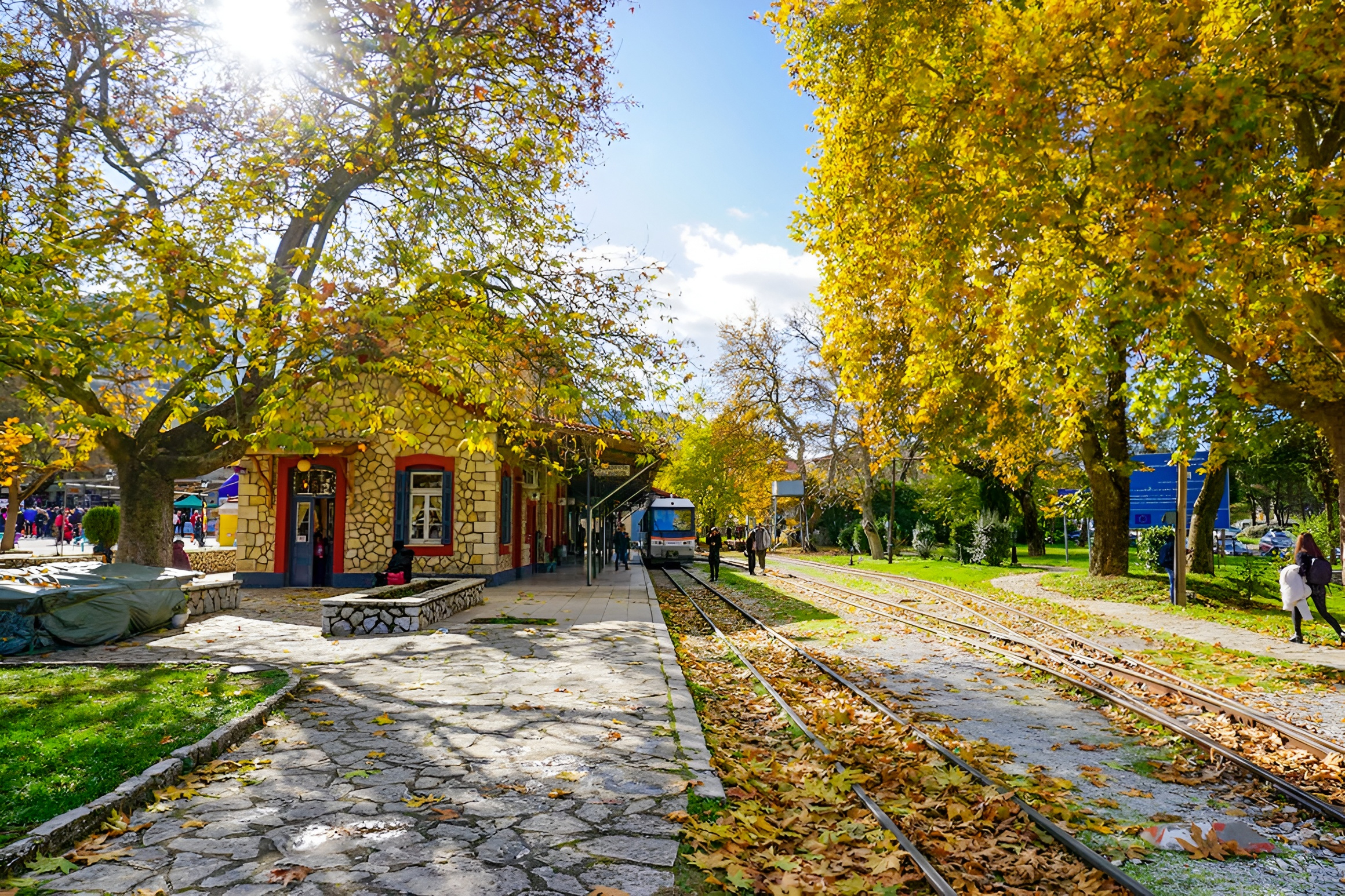
Located within easy reach of the Attica region and the Achaean capital of Patras, Kalavryta stands out as a destination rich in natural beauty, significant cultural and historical landmarks, and a popular ski resort. It is an excellent travel choice for families, groups of friends, and solo travelers alike. Kalavryta is an ideal destination, especially since it is well developed for tourism; visitors will find everything they need there without requiring extensive preparation before their trip. Here, nature and history intertwine and unfold vividly before your eyes.
You can experience the beauty of nature by crossing the Vouraikos Gorge, watching the historic rack railway climb to an altitude of 750 meters on its way to Kalavryta. A visit to the site of the Kalavryta Holocaust Memorial is a powerful moment of remembrance and respect, while the Cave of the Lakes invites visitors into its fascinating underground world.
The welcoming and cosmopolitan Kalavryta Ski Center adds a lively recreational character to the town, while plane-tree forests, scenic landscapes, and important religious landmarks—such as the Monastery of Mega Spilaio—create a complete picture where the modern and the traditional meet in harmony. This experience is complemented by excellent local cuisine and the warmth of genuine Greek hospitality.
Standing proudly between its rich past and promising future, Kalavryta has established itself as a destination that bridges every traveler’s needs, offering memorable experiences in the here and now.
Mega Spileo
Cave of the Lakes
Kalavryta Ski Center
Places to visit in the area
Vouraikos Canyon
Is one of the most beautiful natural sights in GREECE. It has been mentioned as the most beautiful train trip in Balkans. The little train incorporated so well into the natural environment that it seemed that it had always been there. Using stone and wood from the area the technicians’ work is so perfect that someone may think that nature worked on its own. A train ride you will never forget! The Vouraikos Gorge forms a deep and incredibly beautiful gorge. It starts between Helmos and Panachaikos mountains and it reaches the Diakopto seaside town. Vouraikos River springs from the mountains in Kalavrita and exits at the Corinthian Gulf next to the beach of Diakopto. The gorge is rich in flora and fauna and it is part of the network Natura 2000.
Zachlorou
From the walks in the village that stretches from the train tracks and beyond to the most exciting hikes on the small path that looks like flying next to the river waters, it is a village that resembles a green painting, lost in the most beautiful corner of the Achaean nature. The small and picturesque Zachlorou has only 38 permanent residents and therefore few houses, all built in traditional style with chimneys that smoke warmth and coziness in the cold winter months.
The Holy Monastery of Mega Spileo
Is built on the slopes of a steep side of a rocky hill, at a height of 924m, providing great views from its balcony. The monastery’s architecture reminds of a fortress and it has eight floors. The cells of the monks are built around a cave. The Monastery of Mega Spileo was originally built in 362 AD by two brothers, Symeon, and Theodore when a shepherd girl found an icon of the Virgin Mary inside a cave. The icon was made of wax and mastic and it is believed that Apostle Luke painted it. In 840 AC, Mega Spileo Monastery was burnt down by a religious group, known as Iconomachs. It was rebuilt in 1285 by the emperor Andronikos Paleologos but suffered many destroying fires along its history. In fact, a fire in 1600 burnt down the valuable library of the Monastery which had many rare manuscripts. Another fire in 1934 destroyed some precious relics. Two years later, the monastery was rebuilt but in 1943, it suffered another destruction: the Nazi German troops, after the massacre in Kalavryta, put the Monastery of Mega Spileo on fire and killed its twelve monks and its staff, either shooting at them or throwing them from the rocks. Some managed to survive, hidden in close caves after having taken some valuable icons with them.
The Cave of the Lakes
Is known for its impressive succession of cascading terraced green and turquoise lakes on three levels. It is unique in Greece and one of the most extraordinary settings of its kind in the world, where significant finds were discovered tracing back to the Late Neolithic, the Early, Middle and Late Bronze Ages and the Early and Middle Helladic periods. Part of the cave was first discovered in 1964 by villagers from Kastria, while an expedition by the Greek Mountaineering Association, with the participation of cavers from Greece and abroad, took place a few years later. In 1981, the Greek National Tourism Organisation (GNO) commenced excavation works to open up the cave to the public, which happened for the first time in 1990. The cave features a total of 13 lakes. The Cave of the Lakes is even more spectacular during winter or spring when there is more water.